

The way people search is changing. A recent analysis published by Search Engine Land found a noticeable shift in Google Ads search behaviour: shorter queries are losing ground, while longer, more detailed searches are accounting for a growing share of impressions and conversions.
That caught our attention. With AI changing how people discover, research and compare their options online, search behaviour is evolving too. But we wanted to know whether the same pattern was playing out specifically within the independent hotel sector.
So, we looked at our own Google Ads data. And while the picture for independent hotels isn’t identical to the wider study, there are some interesting similarities, particularly when we look at the searches that ultimately convert.
First, what is happening to Google searches?
The original study found a significant shift away from very short search queries.
Since January 2025, impressions from one- and two-word searches have fallen substantially, with much of that share moving towards three- and four-word queries. Longer searches have also gained ground.
The change becomes even more interesting when looking at conversions. One- and two-word queries had previously accounted for 62% of conversions, but their share fell by 10 percentage points over the following year. Meanwhile, conversion share from five- to six-word searches tripled and the share from searches containing seven or more words quadrupled.
The suggestion? As people get closer to making a decision, their searches may be becoming more detailed and specific.
But does the same apply when someone is searching for a hotel?
What we found in independent hotel searches
To find out, we analysed Google Ads search data across our independent hotel clients, comparing January 2025 with August 2026.
We separated the data into branded searches – searches that include a hotel’s brand or property name – and non-branded searches, where someone is searching more broadly for a hotel or stay.
The starting point was already quite different from the broader study. But over time, we can see some of the same movement towards more detailed searches.
Branded searches are getting longer
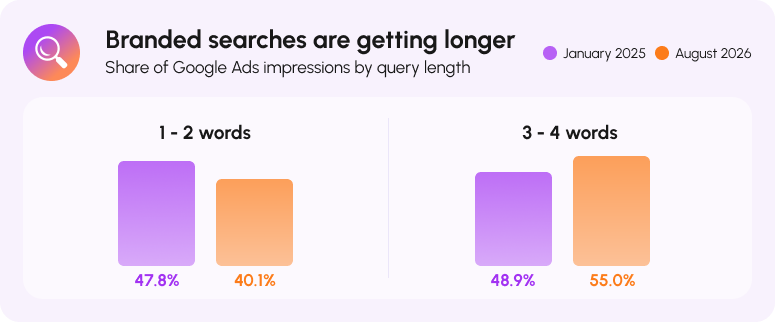
For branded searches, one- to two-word and three- to four-word queries started at almost the same level in January 2025, accounting for 47.8% and 48.9% of impressions respectively.
By August 2026, that balance had shifted. Three- to four-word searches now account for 55% of branded impressions, while one- to two-word searches have fallen to 40.1%.
The same pattern appears in conversions. One- to two-word searches dropped from 57.4% to 46.9% of conversion share, while three- to four-word searches increased from 40.4% to 49.5%.
This suggests that even when guests already know the hotel they are interested in, their search doesn’t necessarily stop at the hotel name.
They may be adding more context to what they’re looking for – whether that’s a particular offer, room type, experience or reason for travelling.
Non-branded search tells a slightly different story
For non-branded searches, three- to four-word queries were already dominant at the beginning of our analysis, accounting for almost 60% of both impressions and conversions.
That hasn’t changed dramatically. What is interesting, however, is what happens further down the conversion journey.
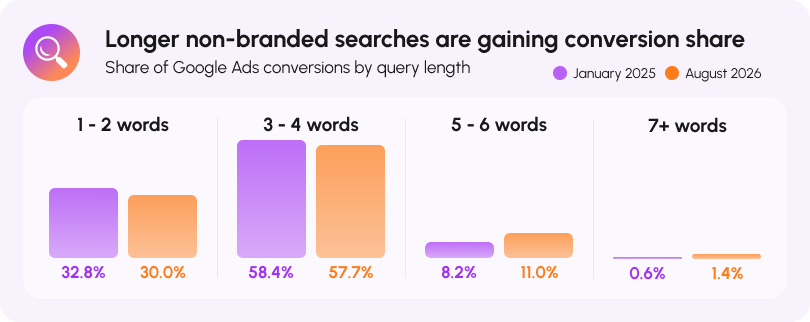
One- and two-word searches have actually increased their share of impressions, from 25.8% to 29.7%. But their share of conversions has fallen from 32.8% to 30%.
Meanwhile, searches containing five or more words now account for 12.4% of conversions, compared with 8.8% in January 2025.
In other words, people are still using shorter, broader searches to discover hotels. But when it comes to the searches that convert, we’re seeing more movement towards longer queries. And that’s where things get interesting for hotel marketers.
What does this mean for your hotel?
We’re not suggesting that every guest is suddenly typing seven-word searches into Google, or that shorter keywords no longer matter. Our data shows they very much do.
Instead, the bigger takeaway is that the searches driving bookings are becoming more specific.
Our data suggests that broader searches continue to play an important role in discovery, while more detailed searches may become more important as guests move closer to booking.
For hotels, that means being visible for the hotel name or a broad destination keyword is only part of the picture. Your digital presence also needs to answer the more specific questions and needs guests bring to their search.
Think beyond “hotel in Dublin” towards the kinds of searches that describe a more specific stay: “family hotel in Dublin”, “spa weekend near Dublin” or “hotel near [attraction]”.
More specific searches give hotels an opportunity to create content that better reflects what guests are looking for. By understanding their interests, questions and needs, you can make your website more relevant and useful at every stage.
Search is changing, and AI is part of the bigger picture
Google Ads data only gives us one window into changing search behaviour, so we shouldn’t treat query length alone as evidence of how AI is changing hotel discovery.
What it does show is another shift in how people search. Guests have more ways to research and compare hotels, from traditional search engines to AI-powered search experiences and generative AI tools. Across all of them, clear, relevant and specific content is important.
For independent hotels, that makes understanding guest intent more valuable than ever.
Want to make your hotel easier to discover as search evolves?
Our AI Discovery Guide explores practical ways to structure and develop your hotel content for a changing search landscape.